For years, the primary purpose of a press release was simple: announce important news and attract media attention.
That role is changing.
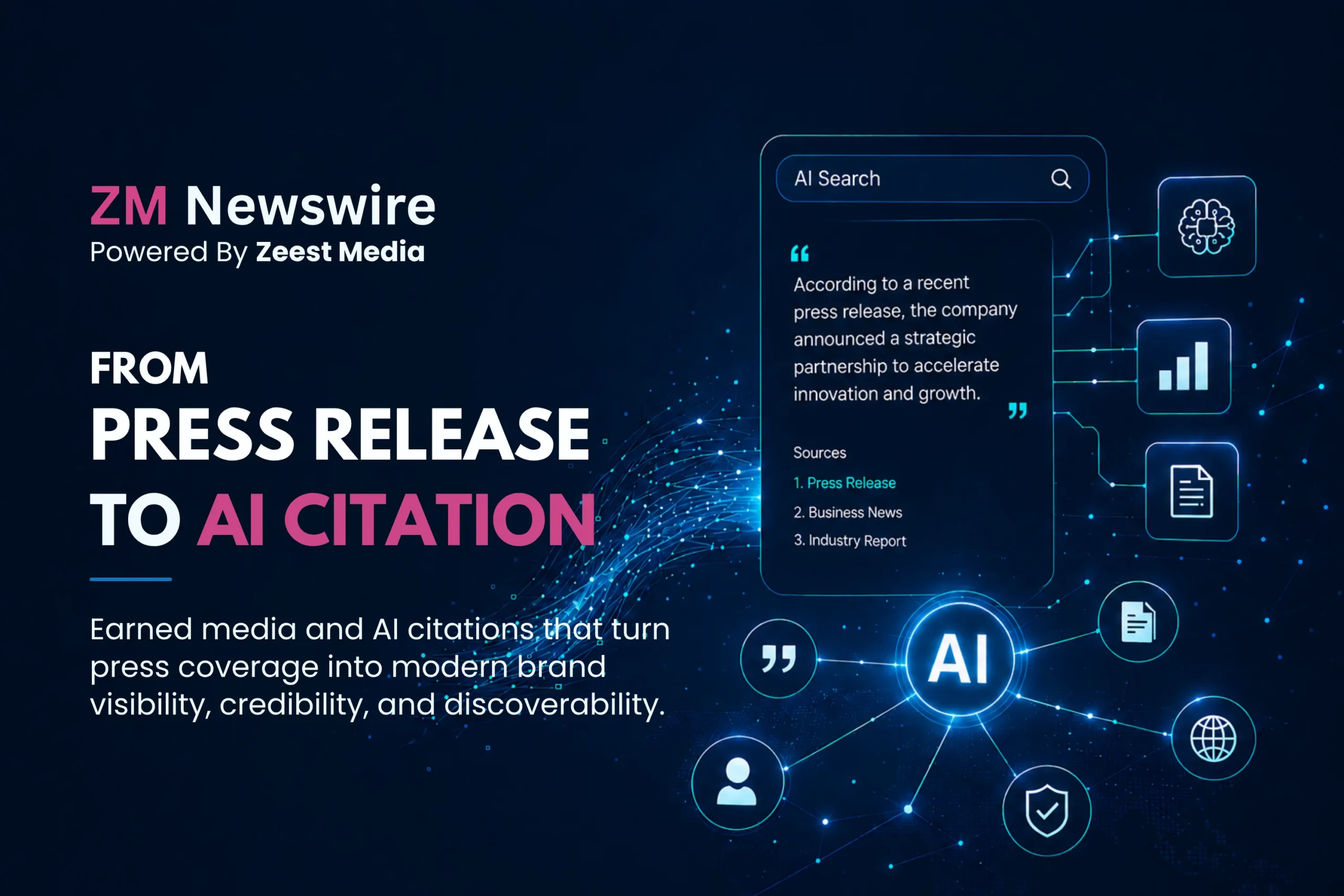
Today, a well-developed press release can become part of a broader digital PR strategy designed to improve brand visibility across search engines, news websites, social platforms, and AI-powered search experiences.
As people increasingly use AI assistants and generative search tools to research companies, products, and services, businesses are competing for more than traditional search rankings.
They are competing to become credible sources that search engines and AI systems can discover, understand, and potentially reference.
This is where earned media becomes increasingly important.
A press release does not guarantee an AI citation, but it can help create the wider ecosystem of credible information that supports modern brand discovery.
What Is Earned Media?
Earned media is publicity a company receives from independent third parties rather than publishing the content itself.
Examples include:
- News and magazine coverage
- Industry publications
- Journalist interviews
- Expert quotes
- Podcast appearances
- Independent reviews
- Analyst coverage
- Editorial mentions
- Industry websites
This differs from owned media, such as a company’s website and blog, and paid media, such as advertisements.
The key difference is independence.
A company can claim that it is an industry leader, but when an independent publication discusses its expertise, product, or research, that creates additional context around the brand.
That third-party context can be valuable for customers, journalists, search engines, and AI-powered discovery systems.
Why Brand Visibility Is Changing
Traditional SEO focused heavily on a simple journey:
Keyword → Search Result → Website
Modern discovery is becoming more complex:
Question → Search or AI System → Sources → Answer → Brand Mention or Citation
A customer might no longer search:
“Best cybersecurity companies.”
Instead, they may ask:
“Which cybersecurity companies specialize in helping small healthcare businesses?”
The search system must understand the question, identify relevant companies, evaluate available information, and produce an answer.
This means brand visibility increasingly depends on how well a company is represented across the web, not just how optimized its own website is.
The Role of Press Releases in Modern Digital PR
Some marketers believe press releases are no longer useful.
The bigger problem is using them as the entire marketing strategy.
A modern press release should be one part of a larger visibility process:
Newsworthy announcement → Press release → Distribution → Media interest → Earned coverage → Brand references → Greater visibility
The goal isn’t simply to publish the same announcement across as many websites as possible.
The stronger objective is to create a genuinely newsworthy story that journalists and relevant publications may want to cover independently.
Press Release Distribution vs. Earned Media
These terms are often confused.
Press Release Distribution
Distribution puts an announcement in front of journalists, news outlets, industry audiences, and potential readers.
It can be useful for:
- Product launches
- Company announcements
- Partnerships
- Research
- Funding
- Executive appointments
- Business expansion
- Events
- Major milestones
Earned Media
Earned media happens when an independent publication, journalist, expert, or organization decides to mention or cover your story.
A press release is brand-controlled communication.
Independent media coverage provides third-party context.
Both can support a modern digital PR strategy.
How Earned Media Can Support AI Search Visibility
AI-powered search systems need information and context to understand brands.
Imagine a technology company that appears across:
- Its official website
- Technology publications
- Industry websites
- Expert interviews
- Business news articles
- Industry directories
Each source may provide different information about the company.
One article may discuss its product. Another may explain its expertise. Another may mention its CEO or research.
Together, these references create a broader digital entity footprint.
This does not mean AI systems simply count mentions and automatically cite a company.
Search and AI systems evaluate many factors, including relevance, source quality, context, freshness, and corroboration.
However, high-quality third-party coverage can contribute to a stronger online presence and clearer understanding of a brand.
From Backlinks to Brand Entities
Backlinks remain important in SEO, but modern brand visibility goes beyond links.
A company can benefit from being:
- Mentioned by reputable publications
- Associated with a specific industry
- Referenced alongside relevant topics
- Quoted by journalists
- Included in industry discussions
- Mentioned in research
- Associated with specific products and services
This is why businesses should ask more than:
“How many backlinks do we have?”
A better question is:
“What does the web say about our company?”
That question moves the focus from simple link building toward brand authority and entity visibility.
The Connection Between Digital PR, SEO, and GEO
SEO, digital PR, and Generative Engine Optimization (GEO) are different disciplines, but they increasingly overlap.
SEO
Improves visibility in traditional search engines.
Digital PR
Builds awareness, media coverage, authority, and third-party references.
GEO
Focuses on improving a brand’s visibility and representation in AI-generated search experiences.
A modern strategy can connect all three:
Digital PR → External authority
SEO → Owned content discoverability
GEO → AI-oriented brand visibility
Together, they create a more complete digital presence.
What Makes a Press Release More Valuable?
Not every press release has the same potential.
A stronger release should provide something genuinely useful or newsworthy.
1. A Clear News Angle
Ask:
Why should anyone care about this announcement?
Strong angles can include:
- Original research
- New technology
- Major partnerships
- Market expansion
- Industry data
- Product launches
- Significant business milestones
Avoid generic promotional announcements that provide little useful information.
2. Original Information
Original research and data can make a story more valuable.
Businesses can publish findings related to:
- Customer behavior
- Technology adoption
- Industry trends
- Market conditions
- Consumer preferences
Original information gives journalists and publications something worth referencing.
3. Specific Facts
Replace vague claims with useful information.
Instead of:
“Our revolutionary platform delivers exceptional results.”
Explain:
- What the platform does
- Who it serves
- What problem it solves
- Where it is available
- Relevant statistics
- Verified results
Specific information provides context for both readers and search systems.
4. Consistent Brand Information
Keep company information consistent across:
- Website
- Press releases
- Business profiles
- Social media
- Industry directories
- Media coverage
Consistent company names, descriptions, locations, products, and leadership information help create a clearer brand identity across the web.
How to Build a Press Release-to-AI Visibility Strategy
A practical strategy can follow these steps.
Step 1: Find a Genuine Story
Start with the news rather than the keyword.
Ask:
- What changed?
- What’s new?
- What problem are we solving?
- What data do we have?
- Why does it matter now?
Step 2: Support the Story With Evidence
Use statistics, research, expert commentary, customer results, or industry context wherever possible.
Step 3: Optimize for Discovery
Include relevant information such as:
- Company name
- Product or service
- Industry
- Location
- Key people
- Important dates
- Official resources
Use keywords naturally rather than stuffing them into the release.
Step 4: Distribute Strategically
Choose distribution channels and publications relevant to your industry and audience.
A healthcare announcement should target healthcare media.
A technology story should target relevant technology publications.
Relevance is more valuable than volume.
Step 5: Create Additional Content
One announcement can become:
- Blog content
- LinkedIn posts
- Videos
- Podcasts
- FAQs
- Research articles
- Case studies
- Executive commentary
This extends the life of the original story.
Step 6: Pursue Independent Coverage
Offer journalists useful resources such as:
- Expert commentary
- Original statistics
- Interviews
- Research
- Industry analysis
The goal should be to become a useful expert source, not simply to request a link.
How to Become More Citable in AI Search
There is no guaranteed formula for getting cited by ChatGPT, Google AI experiences, Perplexity, or other AI platforms.
However, businesses can improve the quality and discoverability of their information.
Publish authoritative content
Clearly explain your company, products, services, expertise, and methodology.
Create original research
Unique data gives journalists and other websites something valuable to reference.
Earn relevant media coverage
Focus on reputable publications within your industry.
Demonstrate expertise
Make knowledgeable executives and subject-matter experts available for interviews and commentary.
Maintain consistency
Keep business information accurate across the web.
Build topical authority
Create useful, comprehensive content around the subjects your business genuinely understands.
What Brands Should Avoid
Modern digital PR should not become a numbers game.
Avoid:
Mass low-quality press releases
Publishing everywhere does not automatically create authority.
Keyword stuffing
Write for humans first. Search optimization should remain natural.
Irrelevant media placements
A few relevant publications can be more valuable than many unrelated mentions.
Fake authority
Fake reviews, fabricated statistics, or misleading claims can damage long-term reputation.
Chasing AI citations directly
There is no legitimate shortcut that guarantees an AI citation.
Instead, focus on becoming the type of credible source worth citing.
Measuring the Impact of Earned Media
Businesses can measure digital PR through several signals:
- Brand search growth
- Referral traffic
- Quality backlinks
- Brand mentions
- Media placements
- Share of voice
- Organic search visibility
- Relevant AI-generated brand mentions
AI visibility should be measured carefully because AI-generated answers can change frequently and there is no universal equivalent of a traditional search ranking position.
The goal is to look for broader trends rather than expecting guaranteed placement.
The Future of Brand Visibility Is Multichannel
Customers can discover businesses through:
- AI search tools
- News websites
- Social media
- YouTube
- Podcasts
- Industry publications
- Business directories
- Online communities
This means brands should stop viewing visibility as a single ranking position.
Instead, think of your online presence as an ecosystem of information and evidence.
Your website explains what you say about yourself.
Earned media shows what independent sources say about you.
Reviews demonstrate customer experiences.
Expert commentary demonstrates knowledge.
Together, these sources can help establish a stronger digital identity.
Press Releases Are the Beginning, Not the End
The biggest shift is conceptual.
A press release should not always be treated as the final marketing asset.
It can become the starting point for a broader earned-media strategy:
Newsworthy event
↓
Strategic press release
↓
Distribution
↓
Journalist discovery
↓
Independent media coverage
↓
Brand mentions and references
↓
Greater authority and entity context
↓
Search and AI discoverability
↓
Potential AI citations
There are no guarantees at any individual stage, but each stage can strengthen the overall digital presence.
Final Thoughts
Press releases are still relevant in 2026, but their role has evolved.
The objective should not simply be to publish an announcement and collect links.
A stronger strategy combines press release distribution, digital PR, SEO, earned media, original research, expert positioning, and GEO.
The ultimate goal is to build a brand that is consistently represented across credible sources.
Instead of asking only:
“How do we rank for our keywords?”
Businesses should also ask:
“How do we become a credible, recognizable, and well-documented source that people and AI-powered search systems can understand?”
That is the real opportunity behind the shift from press release to AI citation.
Frequently Asked Questions
Can a press release guarantee an AI citation?
No. Publishing or distributing a press release does not guarantee that ChatGPT, Google, Perplexity, or another AI system will cite a company.
Are press releases still useful for SEO?
Yes. Their greatest value is often as part of a broader digital PR strategy that can generate discovery, media attention, legitimate references, and brand awareness.
What is the difference between earned and owned media?
Owned media is content controlled by the company, such as its website and blog. Earned media is independent coverage or mention from journalists, publications, experts, or organizations.
How does digital PR support GEO?
Digital PR can increase the amount of credible information available about a company across the web. Relevant third-party sources can provide additional context for AI-powered search systems.
Should businesses focus only on backlinks?
No. Backlinks are useful, but businesses should also focus on relevant media coverage, brand mentions, topical authority, expert positioning, and consistent business information.
How can a company improve AI search visibility?
Publish authoritative content, create original research, maintain consistent business information, demonstrate expertise, and earn relevant third-party coverage. There is no guaranteed AI citation strategy.

Written by
Zeest Media
Expert contributor at Zeest Media - covering PR, GEO, and digital media strategy.